Authored by Jessica Flindell
If you walked through Melbourne’s Bourke Street Mall this past summer and felt compelled to stop and look up, you were not alone.
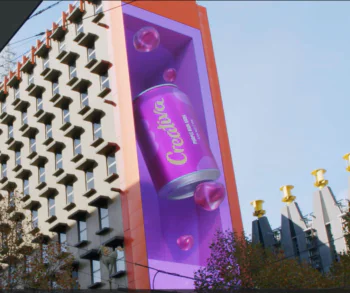
For the launch of Lenovo’s Legion 9i, Creativa transformed one of the city’s most iconic video billboards into a portal to another world. A fantasy sci-fi universe, dark and neon-charged, pulled from the bones of online gameplay and broke through the frame and into the street below. Skeleton claws, magical staffs, and robotic arms loomed over passers-by, all anchored to a single Lenovo laptop at the centre of it all.

The technology making it possible was 3D anamorphic animation, a format that creates the illusion of depth on a flat outdoor canvas. Behind the spectacle was a meticulous process of modelling, animation, and technical problem-solving that most people walking past would never think to imagine.
We sat down with 3D animator Julian Rodriguez to find out how it all came together.
The Brief
Q: When this project first landed, what was the core creative challenge?
Julian: Every 3D project comes with different challenges. On this one it was particularly about modelling the laptop from image references, creating a constantly cycling RGB keyboard light, and capturing the unique texture on the laptop’s lid.
Q: What does animating for a 3DA billboard demand that a standard screen-based piece does not?
Julian: Mainly, to create the illusion of objects coming out of the screen. That is the whole premise of the format, and everything you do has to serve that.
Designed To Break Through
Q: The creative direction drew on the Legion 9i’s existing visual world. How did that shape the animation work?
Julian: The direction called for something rooted in the branding people already associate with the Legion 9i, that dark, neon gaming aesthetic from their TVCs and gameplay footage. The vertical architecture of the billboard gave us multiple levels to work across, which opened up a lot of possibilities for how elements could break through the frame.
Q: There was also a robot in the piece that had to be created from scratch. How did that come together?
Julian: Lenovo did not have the exact robot they wanted to use, so we had to create one with a similar shape. That part was actually a lot of fun.
Q: Can you walk us through the key stages of the animation process?
Julian: It comes down to blocking, timing, offsetting, and cleaning animation curves. Blocking is posing the character or object into key positions to establish the general movement and performance. After that it is about offsetting some of those movements to create more realism and fluidity. Then finally polishing the animation curves so everything eases in and out naturally, with no hard edges that would break the illusion.
Side-by-side view of the production process: the Animatic, Pre-vis, and Viewport Render shown together.
The Team
Q: This project brought together Russell, Sarah, Monica, and Will alongside you. How did that collaboration shape your work?
Julian: Having someone else across other parts of the video really helps to focus and polish certain animations or objects in the scene. When each person can go deep on their part of the work, the whole piece benefits.
Q: Finally, what went into the finished piece that most people watching would never pick up on?
Julian: The pattern on the back of the laptop and the detail in the robot’s texture. It is so small and quick in the animation that you can barely notice it.
The Details Nobody Sees
That is the paradox of animation at this scale. The harder the details are to get right, the less likely anyone will ever notice them. And the faster they vanish on screen.
Julian points to two in particular: the texture pattern on the back of the laptop lid, and the fine grain of the robot’s surface. Both were rendered with a precision that the scale and pace of the animation make almost invisible. “It is so small and quick in the animation that you can barely notice it,” he says. But it is there. And that is the point.
A 3DA billboard lives or dies on the cumulative effect of a thousand decisions like that one. The ones nobody sees are often the ones that make the whole thing feel real.
A big thanks to Lenovo and our partner oOh! media for trusting the team with this one, and for giving Melbourne something worth stopping for.
In case you missed it, watch the 3D Billboard here.
Credits
Producer: Russell Jenkins
Director: Sarah Schwab
Design: Monica Ip
Animation: Will Archer & Julian Rodriguez
Ready to captivate your Audience?

Whether it’s a brand video, product campaigns, animations, or immersive 3D visuals, our team can help you make a big impression.
🎬 Explore our work and see how we help brands find the right creative approach for their story, audience, and goals.
When you are ready to talk through your next project, we are here to start the conversation.
Email: hello@creativa.com.au
Call: (03) 9999 1333